

Quick answer
Key points
- Assumptions come first, results follow: change one assumption and all three statements move with it
- The income statement shows whether you make money, the cash flow statement shows whether you have enough cash, and the balance sheet shows what you own and owe at a point in time
- Early-stage startups mostly use the model to answer two questions: how many months the cash will last (runway), and how much money is still missing (funding gap)
- Long-range numbers are for checking whether the assumptions hold up, not promises
Financial model vs. financial forecast vs. budget
People often use these three terms interchangeably, but they answer different questions. In short, a financial model is a calculation structure you can revise again and again, a financial forecast is the result it produces under one set of assumptions, and a budget is the set of numbers the company has decided to execute against.
| Financial model | Financial forecast | Budget | |
|---|---|---|---|
| What it is | An adjustable calculation structure made of assumptions and formulas | Future numbers the model produces under one set of assumptions | Spending and targets the company has approved, used to manage execution |
| Question it answers | "If the assumptions change, how do the results change?" | "Under today's assumptions, what happens next?" | "How much do we plan to spend, and what do we plan to achieve?" |
| How often it changes | Whenever the assumptions or structure change | When new actuals arrive or assumptions change | Usually on the approval cycle, with a mid-period review |
For how often to update a forecast, see an article on Deloitte Taiwan's website (in Chinese; 2018, republished from Meet Startup). It recommends that startups use rolling forecasts, with the period "often set at 6Q (18M), 12M, or 9M depending on the purpose" (our translation), usually updated monthly or quarterly. This is the article's view, not a fixed practice we recommend.
What goes into a startup financial model
You can build a startup financial model roughly in the order below. Get the assumptions straight first, so the model doesn't get messier with every change.
- Assumptions. Keep the numbers that change, such as price, customer count, costs, headcount, and payment timing, in one place, and note the basis for each one. For how to write them, see How to organize financial model assumptions.
- Revenue. Derive revenue from drivers, for example customer count × unit price, instead of typing in an annual revenue figure. Always use revenue excluding sales tax. Subscription businesses can see SaaS revenue forecast: MRR, growth, and churn.
- Costs and gross profit. Work out the direct cost of each unit you sell; revenue minus those costs is gross profit. See How to calculate gross margin and COGS.
- Headcount. List when each role starts and what it pays. Moving a start date a few months earlier or later changes the shape of your cash curve. See Startup headcount planning and hiring cost.
- The three statements. Once revenue, costs, and headcount are calculated, roll them up into the income statement, balance sheet, and cash flow statement. The next section explains how the three relate.
- Cash, runway, and funding gap. From the month-by-month change in cash, see how many months your cash lasts, how much is still missing, and when you break even. See Startup runway and burn rate and Startup break-even analysis; for how to calculate the funding gap, see "How to Calculate a Funding Gap: Formula, Monthly Cash Flow, and How Much to Raise."
- Scenarios. Make more optimistic and more conservative versions of the key assumptions and see how far the results move. For how, see this article on scenario analysis.
How the three statements link
This section covers general accounting concepts to help you understand how the three statements relate. It doesn't describe how any particular tool calculates.
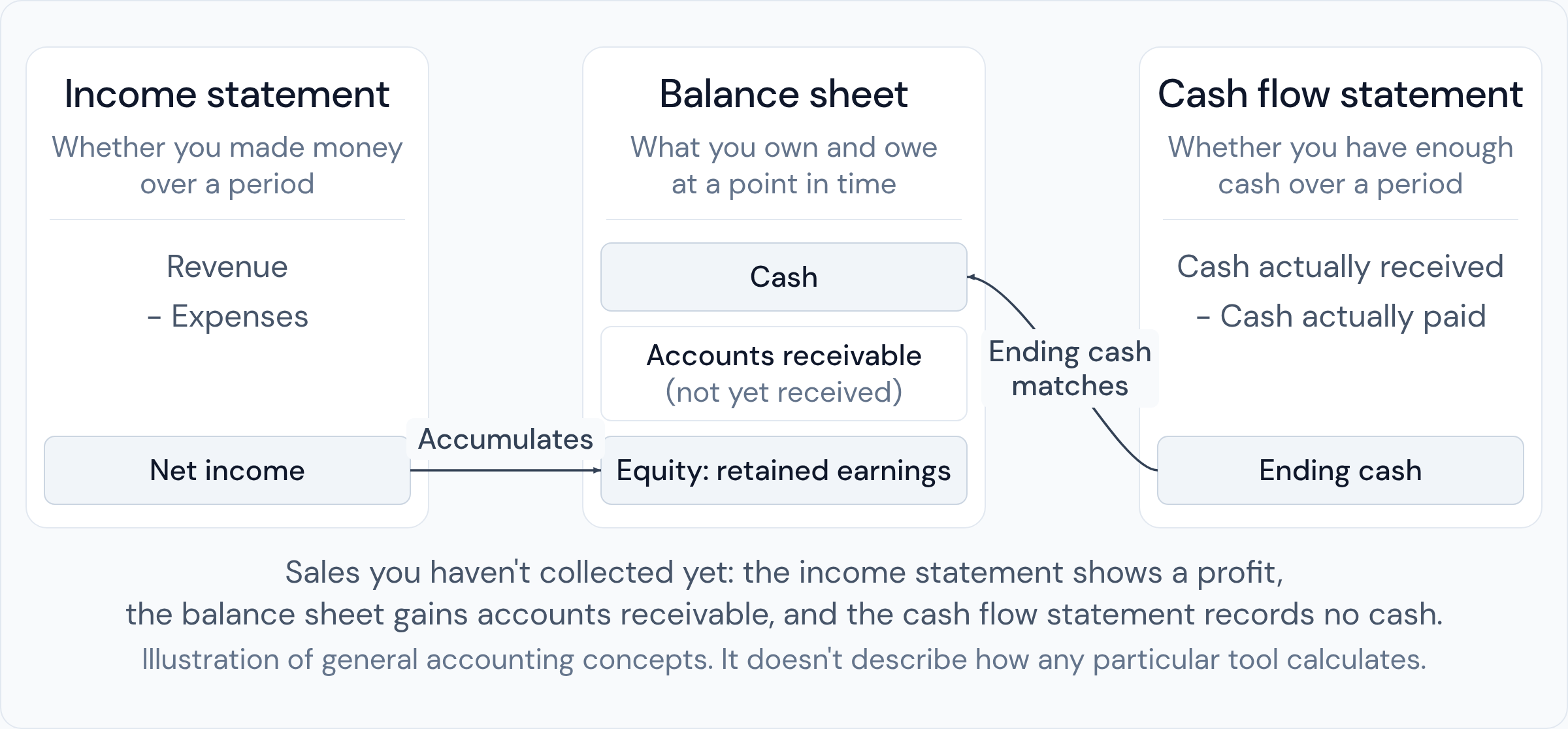
Each statement answers one question. The income statement shows whether you made money over a period; the cash flow statement shows where cash came from and went over the same period; the balance sheet shows what the company owns and owes at a point in time. Under the international accounting standard IAS 7, the cash flow statement presents the change in cash over a period and classifies cash flows into operating, investing, and financing activities.
From the income statement to the balance sheet
Net income for the period accumulates into "retained earnings" within equity on the balance sheet.
From the balance sheet to the cash flow statement
Money from sales you haven't collected yet is recorded as "accounts receivable." At that point the income statement shows revenue but the cash hasn't arrived, so being profitable doesn't mean having cash.
Illustrative example: two months of "profitable, yet cash went down"
All figures below are illustrative. They don't represent any real company and aren't industry benchmarks.
- Amounts are in NT$ thousands (5,000 = NT$5,000,000)
- Opening cash is 5,000, all from shareholder capital
- Revenue is 1,000 a month, and customers pay the following month
- Expenses are 800 a month, paid in cash in the same month
- No tax, depreciation, or borrowing
| Month | Revenue | Expenses | Net income | Cash received | Cash paid | Ending cash | Accounts receivable | Retained earnings | Total assets (cash + receivables) | Share capital + retained earnings |
|---|---|---|---|---|---|---|---|---|---|---|
| M1 | 1,000 | 800 | 200 | 0 | 800 | 4,200 | 1,000 | 200 | 5,200 | 5,200 |
| M2 | 1,000 | 800 | 200 | 1,000 | 800 | 4,400 | 1,000 | 400 | 5,400 | 5,400 |
Check (illustrative figures): M1 ending cash = 5,000 + 0 − 800 = 4,200; M2 = 4,200 + 1,000 − 800 = 4,400; in both months, total assets equal share capital of 5,000 plus retained earnings.
How to read it:
- In M1, net income is 200, yet cash fell by 800, because the revenue is still sitting in accounts receivable.
- In M2, the company collects M1's sales, and only then does cash recover.
- Across the two months, net income totals 400, yet ending cash is 600 lower than opening cash; the difference of 1,000 is the receivables not yet collected (illustrative figures).
To work through a model yourself, follow the Academy's Northstar Notes practice tutorial, Build your first model manually, step by step.
Cash, runway, funding gap, and break-even
Once the model is built, the four metrics founders come back to most are the ones about whether there's enough money.
| Metric | Definition |
|---|---|
| Month-end cash | Month-end cash = last month's ending cash + cash actually received this month (including funding received) − cash actually paid this month. The exact method is in "How to Calculate a Funding Gap: Formula, Monthly Cash Flow, and How Much to Raise"; this article doesn't go into it |
| Runway | Calculated from current cash and planned funding: how many months you can last before cash first drops below 0. If cash never drops below 0 during the period, runway is longer than the forecast period |
| Funding gap | Funding gap = max(0, −lowest month-end cash in the calculation period); the calculation period runs from month 1 through the break-even month. If you never break even within the forecast period, calculate through the end of the forecast; if cash turns negative again or goes deeper after break-even, use the lowest point of the whole period. The funding gap is the minimum amount that just keeps you from running out of cash, not a recommended amount to raise |
| Break-even | The first month with operating profit above 0 that is followed by 3 more consecutive months of operating profit above 0. Exclude one-time income, such as milestone payments, upfront or one-time license fees, grants, and asset sales. If you never break even within the forecast period, write "not yet at break-even within the forecast period" |
In one line: runway tells you when you run out of money; the funding gap tells you how much you're short.
For how to calculate these four metrics, with examples, see "How to Calculate a Funding Gap: Formula, Monthly Cash Flow, and How Much to Raise."
How detailed should the model be at each stage
There's no single standard for how detailed a model should be; it mostly depends on the company's stage and what the model is for. Here are a few views from named sources:
- Just starting (pre-seed, angel): NTU Taidah Entrepreneurship Center (NTU TEC) recommends getting a 12 to 18 month model right first, rather than rushing into a polished five-year forecast. In this early period, a monthly model gives a clearer view of cash.
- Preparing a fundraising deck: A common practice is 3 to 5 years of annual projections. BFA notes that anything from 18 months to 5 years is used, with the 12-month monthly projection being the most important; Taiwan Arena, writing about pitch decks, also puts in a 3 to 5 year overview of profit and growth.
- Industries with long R&D periods, such as new drugs: PhRMA states that a new drug takes 10 to 15 years on average from research to FDA approval; Taiwan's Food and Drug Administration also said on its Facebook page (in Chinese) that developing a drug takes about 10 to 15 years (Liberty Times Net Health, 2024-07-12). Models for these companies may need to look further ahead.
Forecasts in Tessly (a financial modeling platform built by Tessera Design) run up to 10 years, and you can choose 3, 5, or 10 years. For how many years to build and how to balance the early and later years, see How to Build a Startup Financial Forecast: 3, 5, or 10 Years?.
However many years you build, the further out a number is, the less certain it is. Its job is to check whether the assumptions make sense over the long run, not to make a promise to investors.
What investors ask when they review a financial model
Every investor focuses on different things, but it's worth having answers ready for these five before the meeting:
- The basis for your revenue assumptions: where customers come from, how you set prices, and what justifies your growth rate.
- Gross margin structure: for each extra unit you sell, how much is left after direct costs.
- When headcount grows: the start date for each role, and the trigger behind it.
- How long the cash lasts and how much is still missing: in other words, runway and funding gap.
- Which milestones this round buys: where the company will be when the money runs out.
To prepare, read Investor financial model review first, then work through the 12 questions to answer before fundraising one by one.
How a financial model relates to valuation
Valuation isn't a separate, standalone calculation. Valuation methods such as DCF and rNPV all rely on the cash flows your financial model produces.
In Tessly, DCF and rNPV read the same financial forecast you built in Tessly. DCF uses the number of forecast years you chose and does not automatically extend to ten years.
For which valuation methods suit which stage and how to calculate them, see "How to Value a Startup: DCF, the VC Method, or rNPV, and Which to Use at Each Stage."
5 common startup financial model mistakes
- Using the same growth rate every year with no explanation. A growth rate should break back down into drivers such as customer count and unit price.
- Treating profit as cash. As in the illustrative example above, the income statement can show net income while cash shrinks because customers pay late.
- Hiring everyone at once with no triggers. Roles should be added as revenue, customer count, or product progress grows, with the triggers written down. Put everyone at the start and cash gets tight early, and it's hard to explain to investors.
- Counting one-time income toward break-even. Milestone payments, upfront or one-time license fees, grants, and asset sales don't arrive every month, so exclude them when judging break-even.
- Running only one scenario. With only one set of assumptions, you can't see which assumption matters most. Prepare at least one more conservative version and see how much cash and the funding gap change.
Excel or a tool?
Both approaches can produce a reliable financial model; the difference is mainly in maintenance and sharing.
Excel or Google Sheets gives you the most flexibility: every formula is visible, and you can trace any number back to its source. The cost is that you design the structure yourself; once you have many assumptions, every time you change a number you have to check for hard-coded values or broken formulas yourself. Sharing usually means emailing files, and with many versions it's easy to get confused.
With a financial modeling tool, the structure is already built, and when you change an assumption the related results recalculate. The cost is that your flexibility is limited by the tool's design. On sharing, many tools let you share a read-only version with investors directly, with no more files going back and forth.
For a comparison of the two approaches, see "How to Choose a Startup Financial Forecasting Tool: Excel Templates, Google Sheets, and Modeling Software Compared (2026)."
Build a financial model in Tessly
Here is how Tessly's live site currently works.
- Start from assumptions. Build your financial forecast from assumptions; change one assumption and the related results recalculate.
- Choose 3, 5, or 10 years. Tessly builds a ten-year model by default, and you can switch to 3 or 5 years. The path for the whole forecast period (up to ten years) is built with a monthly model.
- Cash metrics are calculated together. Tessly calculates month-end cash, runway, funding gap, and break-even, with the same definitions as the table above. When cash has turned negative, the screen shows "Cumulative Funding Gap"; when cash has never turned negative, it shows "Minimum Cash Balance."
- Share with investors. You can share a read-only snapshot of the model for investors to review; scenarios an investor adjusts stay in their own case and don't change your original model.
Put your assumptions into Tessly, and month-end cash, runway, and funding gap are calculated together. → Start building
---
This article is educational content and does not constitute investment, accounting, or financial advice.
FAQ
FAQ
Is a financial model the same as a financial forecast?
No. A financial model is a calculation structure made of assumptions and formulas; a financial forecast is the future numbers the model produces under one set of assumptions. Change the assumptions and you get a different forecast.
Can you build a financial model before you have revenue?
Yes. Start with launch timing, pricing, customer acquisition pace, and monthly spending, and first work out how many months the cash will last and how much is still missing. Don't treat unvalidated targets as committed revenue.
How many years should a startup financial model cover?
There's no fixed number. Early companies should first get a 12 to 18 month monthly model right; when preparing to raise, a common practice is to extend it to 3 to 5 years of annual projections. Industries with long R&D periods may need to look further ahead.
Do you need all three financial statements?
We recommend building all three. The income statement shows whether you make money, the cash flow statement shows whether you have enough cash, and the balance sheet shows what you own and owe at a point in time and lets you check that the whole model balances. With only an income statement, it's easy to mistake profit for cash.
How often should a financial model be updated?
Update it when new actuals come in or a key assumption changes, such as pricing, hiring plans, or fundraising timing. Many companies put actuals next to the forecast, compare them, and then adjust the assumptions that follow.
Can I build a financial model myself without a finance or accounting background?
Yes. Start with assumptions for revenue, costs, headcount, and cash, and make sure you can explain the basis for every number; then ask someone with finance experience to check that the three statements tie out.
Next step
Put this question back into the full financial model
Continue with the runway and burn rate guide or the 12-question fundraising checklist.